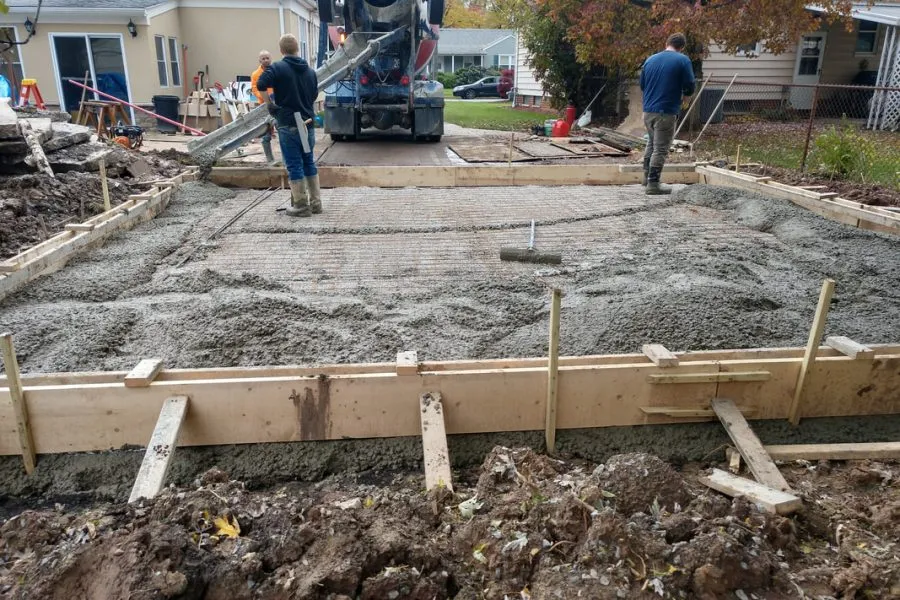
Most driveways and patios are poured in one day after one or two days of preparation. The waiting comes afterwards, and in western Pennsylvania the calendar matters as much as the clock.
How long does concrete take to cure?
Concrete reaches its design strength in about 28 days. It is hard to the touch within a day and gains most of its strength in the first week. Cool weather slows this down. A slab poured in a mild May week moves faster than one poured in late October.
How long before I can walk on new concrete?
You can usually walk on new concrete after one to two days. Keep dogs, bikes and furniture off for a few days longer, since the surface marks easily while it is young.
How long before I can drive on new concrete?
Wait about seven days before you drive on new concrete with a car, and longer in cold weather. Keep heavy vehicles such as moving trucks and dumpsters off for about a month. We tell you the date for your slab when we finish.
How long does it take to pour a driveway?
A typical driveway takes one to two days to tear out and prepare and one day to pour and finish. Steep sites, hand-carried material, drains and walls add days. Rain can push the pour date, and we would sooner wait than place concrete on a soaked base.
Can concrete be poured in the rain?
It should not be poured in the rain. Light drizzle can be managed with covers, but steady rain adds water to the surface and weakens it. Pittsburgh gets rain in every month, so we watch the forecast, keep plastic on the truck and move the date when we have to.
Is it too hot to pour concrete in summer?
Rarely here. It is too hot to pour only on the worst afternoons, when sun and wind dry the surface before it can be finished. On those days we start early, dampen the base and cure the slab so it holds moisture. Summer is otherwise a good season for concrete in this region.
Can concrete be poured in cold or freezing weather?
It can be poured in cold weather with precautions, but not onto frozen ground and not if it will freeze before gaining strength. Fresh concrete that freezes in its first day or two is permanently weakened. In cold spells crews use heated water in the mix, accelerators and insulated blankets. Below a certain point it is better to wait for spring, and we will say so.
What is the best time of year to pour concrete in Pittsburgh?
Late spring through early fall is the best time of year. From about May to early October the ground is thawed, nights stay above freezing and the slab has time to gain strength before winter. Early spring is often too wet and the ground may still be frozen below the surface. Late fall pours face their first freeze too young.
Can I use salt or deicer on new concrete?
Keep salt and deicer off new concrete for its first winter. Use sand or grit for traction. After that, plain rock salt used sparingly is the least harmful common choice. Avoid products with ammonium nitrate or ammonium sulfate, which attack concrete chemically. Shovel early so less deicer is needed, and rinse the slab in spring, especially where the car drips road salt.
How do I look after new concrete in the first month?
- Keep it damp or covered for the first days if we ask you to. Slow drying makes stronger concrete.
- No cars for about a week and no heavy trucks for about a month.
- Do not drag sharp metal across it or turn the steering wheel while standing still.
- Hold off on sealer until we give you the date.
- Point downspouts away from the slab.
For a real number, we need to see the site. Call (412) 725-2024 or text a few photos, and we will set up a free on-site estimate with a written quote.