Some things that worry owners of new concrete are normal, and some are real defects. This page sorts them out. Where a contractor is at fault, Pennsylvania's Home Improvement Consumer Protection Act and the Attorney General's Bureau of Consumer Protection give homeowners a route to complain.
Why is my new concrete already cracking? Is the contractor responsible for a crack that shows up weeks later?
New concrete shrinks as it dries, and thin hairline cracks in the first weeks are common and mostly cosmetic. Whether the contractor is responsible depends on the cause. A fine crack that follows a joint or stays tight is normal behavior. A crack that is wide, has one edge higher than the other, or runs across panels with no joints nearby points to a base, thickness or joint layout fault, and that belongs to whoever built it. Photograph it with a coin for scale and send it to the contractor in writing.
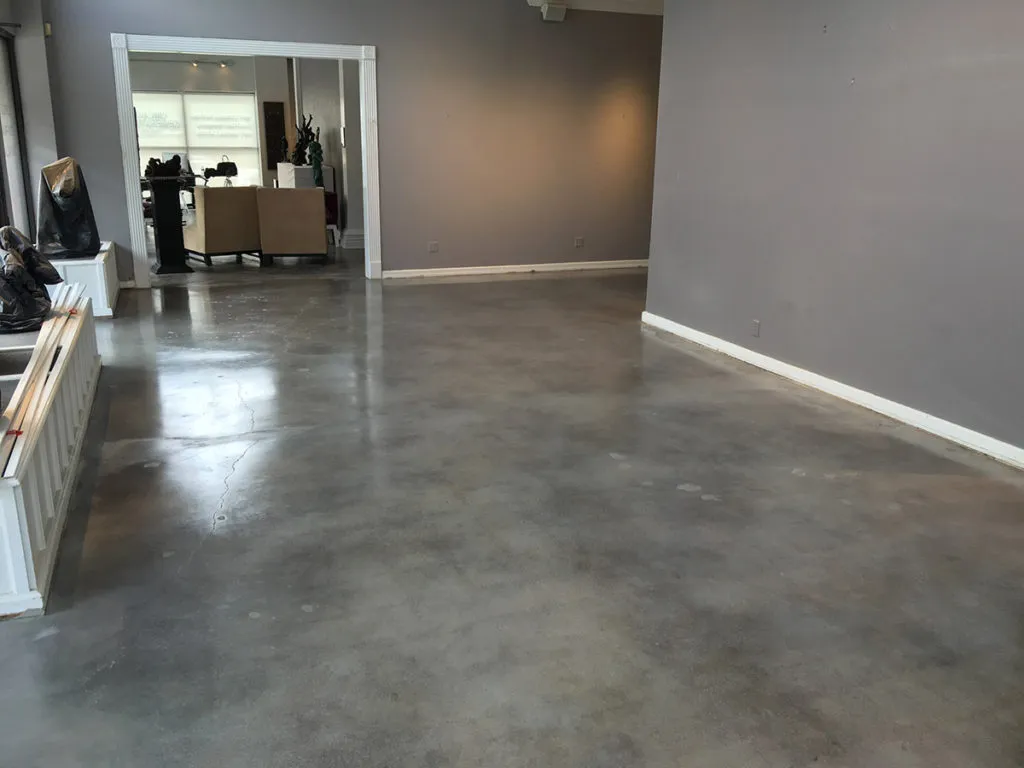
Why does my new concrete have dark and light patches?
Dark and light patches in new concrete usually come from uneven drying. Shaded areas, thicker spots and places where water sat cure darker. Loads from different trucks can also differ slightly. Much of it evens out over the first few months. Blotches caused by sprinkling water or dry cement on the surface during finishing tend to stay.
What happens if it rains on fresh concrete?
If it rains on fresh concrete before the surface has set, the top layer can wash out, turn soft and dusty, or pit. Light rain after the surface has been finished and has stiffened does little harm. Spring and fall showers arrive quickly here, so a crew should have plastic sheeting on site. A surface that was damaged by rain will show it as dusting or early scaling.
There are footprints, rough spots and low spots that hold water. Is that acceptable?
No. Footprints, trowel gouges and a wavy surface with puddles are finishing faults, not normal variation. Small birdbaths can sometimes be ground or filled. Low spots matter more in Pittsburgh than in warm places, because standing water freezes and attacks the surface. Raise it with the contractor before the last payment.
Are control joints really necessary? My contractor wants to saw-cut them a week later.
Control joints are necessary, and a week is too late. Concrete will crack as it shrinks. Joints tell it where. Saw-cut joints are normally made within about a day of the pour, as soon as the saw will not ravel the edge. After a week the slab has already picked its own crack lines. Joints should be about a quarter of the slab's thickness in depth.
My slab was poured without rebar or mesh and I found out afterwards. What now?
Start with the contract. If it promised steel and the slab was poured without rebar or mesh, you did not get what you paid for and should say so in writing. If the contract was silent, it is harder. Plain concrete on a good base can perform for a patio or walk. Steel does not stop cracks. It holds them tight. For a driveway on clay in a freeze-thaw climate, its absence shortens the odds of the panels staying level.
What can I do if the contractor will not come back to fix it?
Put the problem in a dated letter or email with photos and a deadline. If the contractor still will not come back, file a complaint with the Pennsylvania Office of Attorney General, Bureau of Consumer Protection, which enforces the Home Improvement Consumer Protection Act. You can also check the contractor's registration with that office at 1-888-520-6680. For money, the usual route is your local Magisterial District Court. This is general information, not legal advice.
My new stamped concrete is slippery. Can that be fixed?
Yes. Stamped concrete gets slippery when a glossy sealer is applied without grit, and it is worse with frost or wet leaves on it. The fix is to reseal with a non-slip additive mixed in, or to strip the gloss and use a lower-sheen sealer. On a slope or steps, ask for the grit from the start.
Why is my stamped concrete cloudy, fading or peeling?
Cloudy or white patches mean moisture is trapped under the sealer. It happens when sealer goes on too thick, onto damp concrete or in cold weather. Peeling follows from the same cause. Fading is sun and wear on the color. A solvent wash can often re-melt and clear a cloudy sealer. Badly built-up sealer has to be stripped and redone in thin coats on a dry day.
The surface is flaking after its first winter. Whose fault is that?
Scaling in the first winter is usually a concrete or timing problem, with salt as the trigger. Concrete placed late in the fall may not have gained enough strength before the first freeze. A mix without air entrainment, or a surface finished with added water, scales easily. Deicer used in the first winter makes all of it worse, and so does salty slush dripping from a parked car. Ask the contractor for the delivery ticket, which shows the mix that was ordered.
It was poured in extreme heat and now looks bad. Is it ruined?
Not always. Concrete poured in high heat and wind dries too fast on top, which leaves fine surface cracks and a weak, dusty skin. If the damage is only at the surface, it can be treated with a hardener or resurfaced. Deep cracking across the slab is a different matter. Pittsburgh summers are milder than the South, but a July afternoon pour in full sun still needs shade, damp curing or an early start.
The stamped pattern is crooked and uneven and I still owe the final payment. Should I pay?
Hold a reasonable part of the final payment until the fault is dealt with, and tell the contractor why in writing. A crooked or half-pressed stamp pattern cannot be re-stamped once the concrete is hard. The options are grinding and an overlay, replacing the worst panels or agreeing a price reduction. Read your contract for what it says about workmanship and disputes.
The crew left ruts in the lawn, washout and splatter. Is that on them?
Yes. Ruts from equipment, concrete washout dumped in the yard or the street and splatter on siding and garage doors are the contractor's to put right. Washout should never go down a storm drain. Note it on the final walk-through and ask for a date for the repair.
My new pad is out of level and the forms were left on. Is that a problem?
A pad should be slightly out of level on purpose, about an eighth to a quarter inch per foot, so water runs off. If it tips toward the house or is uneven enough to rock a shed or hot tub, that is a defect. Forms are normally pulled within a day or two. Left on for weeks they swell and stick, and prying them off can chip the edges. Ask the contractor to remove them and to check the slope with a level while you watch.
For a real number, we need to see the site. Call (412) 725-2024 or text a few photos, and we will set up a free on-site estimate with a written quote.